
Abonnieren, um weiterzulesen
Schließe ein Abonnement ab, um Zugriff auf den Rest dieses Beitrags und weitere exklusive Inhalte für Abonnenten zu erhalten.
Schließe ein Abonnement ab, um Zugriff auf den Rest dieses Beitrags und weitere exklusive Inhalte für Abonnenten zu erhalten.
I have just finished a super read on World War 1 and how three families are affected by it. The book is also an excellent social history of the period.
John Masters‘ novel – Now, God be Thanked – is a must-read for those of us interested in The Great War and in how it changed society at the time. Masters‘ (1914 – 1983) novel is the first of a trilogy and, in its content, might be placed somewhere between Downton Abbey and All Quiet on the Western Front. I would also describe it as „epic“ in span as it stretches from just a few weeks before the War begins to Christmastide 1915. The subsequent two volumes take the reader to the end of the war.

What struck me most was the undertone of sadness pervading this story of the four families, and the sadness begins with the very title. It was taken from a poem by Rupert Brooke entitled „Peace.“
Now, God be thanked who has matched us with his hour,
And caught our youth, and wakened us from sleeping!
With hand made sure, clear eye, and sharpened power,
To turn, as swimmers into cleanness leaping,
Glad from a world grown old and cold and weary;
Leave the sick hearts that honor could not move,
And half-men, and their dirty songs and dreary,
And all the little emptiness of love!
At the centre of the story are the financially troubled Rowlands, whose automotive business is at a crisis point while domestic problems come to the surface. For example, daughter-in-law Fiona wants to leave her husband Quentin for a Scottish painter while son Tom, a commander in the Royal Navy, is tormented by his homosexuality. Granddaughter Naomi is a suffragette, and young Stella gives her virginity to a wounded captain rather than to Johnny Merritt, a rich Harvard graduate who wants to bring about a merger of the Rowland Motor Company with U.S. capital. Revolving around these people are a variety of socialists, poachers, and poets, and also two Stratton brothers, the Rowlands‘ production-managers, who go off to meet their fate in Flanders fields.
Here is one review of the many good ones from Amazon.uk:
„This trilogy is an epic read. Focussed on a south-east England town, beginning just before the Great War, and finishing just after, it is a collection of interwoven plots that leave the heart grieving for an England, and English people, that once were and will never come again. I challenge you to read these books, and they are all immensely readable, and not come away educated, moved, entertained and informed. WW1 was such a tragedy. But it takes a work like this to bring that tragedy into a fuller realisation than the academic format of history books allows.“
It was February 2024. There I was, standing in central Naples, my head full of memories from more than 40 years previously. My mind was brimming over with pieces of my life, and all of them were connected to a person I no longer was, a person I had left behind many years previously. Later, from the top of a tourist bus, we drove through the streets and the neighbourhoods I used to know only to realize just how different they were. New buildings had been erected; others had been torn down. I knew then that not only had I changed since the 1980s when I had lived there but the place had changed, too. It was a bittersweet feeling to have when I realised that nothing would ever be the same again. All I had were memories, and memories are only loosely connected to reality.
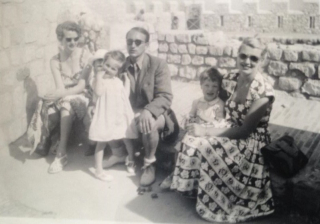
This reality is that a constant process of making connections and reinventing ourselves is going on. Only on reflection can we tell ourselves that the last time we were here (or there) we were about to embark on a new journey of some kind or there was an experience that left us forever changed. We cannot know this at the time! Only on reflection do we look back at our lives and make the past connect with the present. We think we can identify the moments that changed us and made us evolve into the people we are now. Other memories are, perhaps, shoved out of the door because they invite pain. Discarded they remain, if not forgotten, then pushed aside. It’s the human way.
Nonetheless, nostalgia will often have its way. We sometimes immerse ourselves in dreams or romanticize moments of our lives, even if there were so many negative factors involved. Perhaps, this is why some older people talk warmly about moments in their youth when they were struggling. Yes, the present and future may be difficult and painful. Perhaps, romanticising the past allows us to see the good in every situation and this keeps us moving in bad times. Perhaps, romanticising inspires us to believe there is always room for progress. Romanticising the past (and especially the people in it) is very common both in real life and in literature. Think of „Lolita“ by Nabokov, „Le Grand Meaulnes“ by Alain Fournier and „The Great Gatsby“ by Fitzgerald.
It’s 1989 – the year I returned to the UK after a long stay in Italy. After 13 years of seeing children treated like Jesus himself, the first thing I see in England is a piece of white trash walloping her little girl on the legs and shouting, „Shuddup you f…. Little bleeder.“ Rain in August was shocking too.

You start wondering where the friendly policemen are, not to mention the nice old ladies you can help across the road. Why isn’t the music of Elgar playing over rolling green hills around you? In place of these dreams is the supermarket car park near some motorway exit. Oh yes, and who the hell is Margaret Thatcher? International TV was not available in the 1980s, and can someone tell me what FMCG Marketing is?
Why am I writing this now in 2025? Because I just read an article on reverse culture shock. For me, the article comes 35 years too late. Now, apparently, it has become recognised as a problem for companies who send their „people“ on overseas assignments. Long live Capitalism.
Reverse culture shock is a serious problem. Deciding to go „home“ after many years in another culture is not to be taken lightly. „Home“ may no longer feel like home. You can feel isolated and misunderstood. After all those years in Italy, an English interviewer said to me, „Ah, Italy, Mr Goddard. Sunshine, sports cars and beautiful girls! Why do you want to come back to the UK?“
I asked the same thing myself but, unable to answer his question, I decided not to accept his job offer.
Initially, I did not recognise the individual in the photo. Nonetheless, I was curious as to which friend or relative had thought about me enough to send the letter. But there was no letter – at least, not a letter in the sense of a written message on printed paper and sent to me in an envelope. However, there was a blank sheet of paper folded around the photo of an Adonis glaring at the camera. Imagine my surprise then, after a slow dawning, that the Adonis was me. When I say „me“, I mean me as I had been some 35 years ago.

A little earlier, I had been minding my own business (as they say) when the envelope slid through the letter box and fluttered towards the floor. I picked up the envelope and scanned it for clues. French stamp, hand-written address but no information about the sender. I ran a finger over the stamp and wondered which friend or acquaintance from my home town in Germany was now on holiday in France. But I knew of no-one who had recently travelled to France and it was November – not a month I would usually associate with France in general or with overseas visitors in particular.
Slipping my finger under the flap, I ripped the envelope open and pulled out a creased sheet of blank paper. As I did so, a photo, hidden in the paper’s folds, swayed downwards and landed on the floor with the faint sound of wind. Vaguely familiar eyes looked up at me from the floor, locked on to mine, and seemed to ask: „So – who am I?“
Imagine my surprise then, after a slow dawning, that the face of the Adonis in the photo was mine. It was not my „mine“ as I know it to be now, but „mine“ as I had known it to be over 30 years previously. I hardly recognised him!
However, I knew immediately who had sent the letter. Although I had not seen or heard of her for thirty years, I admit I had often wondered about her from time to time. After all, we shared some good times together. The relationship had fizzled out and that, dear reader, was that.
There may well be people out there who disassociate from old loves and lovers and neither see them nor think of them again. I am not one of those people. If I say that I miss a person, it does not mean I still love them. Nor does it mean I am not over them. I will remember all my girlfriends when I am older and greyer than I am now. My own experiences suggest that even if I never see old flames again, they never go away completely.
So – what does the letter mean?
My vanity tells me that she misses me. Reality tells me the letter means nothing at all. Who knows? The human heart is a complicated thing. No wonder it is frequently the topic of films and books. Here are four stories about love and second chances that might interest you.
Maybe in Another Life – Taylor Jenkins Reid
Before we were Strangers – Rene Carlino
Again the Magic – Lisa Kleypas
I Let You Go – Clare Mackintosh
Initially, I did not recognise the individual in the photo. Nonetheless, I was curious as to which friend or relative had thought about me enough to send the letter. But there was no letter – at least, not a letter in the sense of a written message on printed paper and sent to me in an envelope. However, there was a blank sheet of paper folded around the photo of an Adonis glaring at the camera. Imagine my surprise then, after a slow dawning, that the Adonis was me. When I say „me“, I mean me as I had been some 35 years ago.

A little earlier, I had been minding my own business (as they say) when the envelope slid through the letter box and fluttered towards the floor. I picked up the envelope and scanned it for clues. French stamp, hand-written address but no information about the sender. I ran a finger over the stamp and wondered which friend or acquaintance from my home town in Germany was now on holiday in France. But I knew of no-one who had recently travelled to France and it was November – not a month I would usually associate with France in general or with overseas visitors in particular.
Slipping my finger under the flap, I ripped the envelope open and pulled out a creased sheet of blank paper. As I did so, a photo, hidden in the paper’s folds, swayed downwards and landed on the floor with the faint sound of wind. Vaguely familiar eyes looked up at me from the floor, locked on to mine, and seemed to ask: „So – who am I?“
Imagine my surprise then, after a slow dawning, that the face of the Adonis in the photo was mine. It was not my „mine“ as I know it to be now, but „mine“ as I had known it to be over 30 years previously. I hardly recognised him!
However, I knew immediately who had sent the letter. Although I had not seen or heard of her for thirty years, I admit I had often wondered about her from time to time. After all, we shared some good times together. The relationship had fizzled out and that, dear reader, was that.
There may well be people out there who disassociate from old loves and lovers and neither see them nor think of them again. I am not one of those people. If I say that I miss a person, it does not mean I still love them. Nor does it mean I am not over them. I will remember all my girlfriends when I am older and greyer than I am now. My own experiences suggest that even if I never see old flames again, they never go away completely.
So – what does the letter mean?
My vanity tells me that she misses me. Reality tells me the letter means nothing at all. Who knows? The human heart is a complicated thing. No wonder it is frequently the topic of films and books. Here are four stories about love and second chances that might interest you.
Maybe in Another Life – Taylor Jenkins Reid
Before we were Strangers – Rene Carlino
Again the Magic – Lisa Kleypas
I Let You Go – Clare Mackintosh
Is it worth attempting to learn a new language in retirement? Of course it is! But I would add that unless you are a sociable person who actively seeks to converse with others, your oral language skills will not develop as fast as you might like. Yes, you will be able to learn enough of the language to get by, for example, and you will learn enough to ask for something in the supermarket. You might even learn enough to read the newspaper, but learning to speak fluently with native speakers might well prove difficult.
Why is this?
Well, my own experiences as a pensioner in Germany suggests that unless you make friends with other pensioners you won’t have much contact with native speakers. Why is this? Let me say at once that I am not going to criticise Germans here. They are no more or less friendly than other nationalities. However, my experience suggests that older people in general are not as sociable as younger people. And that includes me! When I worked in Italy in 1976 I learned very good Italian in a few months. Why? Because I was out every night in the pizza houses with my students. They wanted the opportunity to speak English but we all ended up speaking Italian, and within 6 months I was fluent.

I am now 72 and living in Germany. I no longer go out to eat every night. I also realise (much to my sorrow) that now I am older I am less inclined to tolerate or adapt. Another problem is that many (but not all) Germans are black and white in their attitudes. You speak German or you don’t. There seems to be little appreciation of „intermediate“ language ability.
My guess is that older people (like me) become less able to adapt. In other words, it is not Germans who are the problem here but the years that bog you down in an unwillingness to change.
So – what are the experiences of others who have chosen to live abroad? Here are some well-known novels on the topic.
Driving Over Lemons: An Optimist in Andalucia – Chris Stewart
Under the Tuscan Sun: At Home in Italy – Frances Mayes
A Year in Provence – Peter Mayle
Out of Africa – Isak Dinesen
A House in Fez – Suzanna Clarke
And, no, that problem is not senility! I think I have a good memory although I have also met people who claim that their memory has worsened with age. Whatever I, or other people, say, it is highly likely that one’s memory probably isn’t as good as one thinks it is – and this is not necessarily due to age. Consider, for a moment, how important memory is. How often do you depend on memory to share stories about your upbringing or past experiences? How often do you begin these stories with words like, when I was a boy or before I got married or let me tell you about the first time I kissed a person? Clearly, we rely on
our memories not only for sharing stories about past events but also for important things like creating our sense of identity. Despite this, there is plenty of evidence to show that our memory is not as accurate as we think it is. Worse than this, we humans are apt to change facts or add false details and we don’t even know we are doing it.
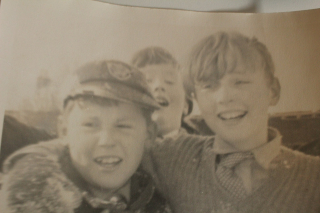
Look at the pic on the left. It shows the author and his best friend in Thames Ditton school playground in the cold winter of 1963 (or was it 1962?). I tell myself that I remember the occasion well and other memories tag along with this one, for example: memories of icy slides, snowball fights, forcing snow down someone’s back, and a warm open fire on my return home. But evidence suggests that although I might think that I remember the event (and its aftermath) recorded in this photo, the very presence of the photo, and having it to hand, has probably already triggered a sense of disengagement with the actual moment so that the brain has encoded the moment less deeply. And the events that tag along with the original event, the slides and the snowball fights, for example, probably belong to another place, another time or to imagination.
And that is not all! Consider for a moment the game of Chinese whispers. In the game, one person quietly whispers a message to the person beside them, who then passes it on to the next person in line, and so on. Each time the message is relayed, some parts might be misheard or misunderstood, others might get innocently altered, improved, or forgotten. Over time the message can become very different from the original. Well, the same thing often or usually happens with memory. For one reason or another, mistakes or additions happen every time we recall past events. These may range from what we believe to be facts or wish to be facts, to what we were told about the past event or what we want the audience to think about us. The point is that whenever these changes occur, they can have a long-term effect on that memory in the future.
For the writer working on his/her autobiography, artistic license might well be used to create a slightly a different story from the original in order to suit the impression needed or to please the intended reader. The writer may ask him/herself whether it’s vital to get the facts straight in the first place. Perhaps the writer wants to change details to suit his intended readers‘ attitudes or political leaning. Research indicates that when we describe our memories differently to different audiences it isn’t only the message that changes, but sometimes it is also the memory itself.
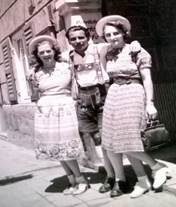
Old photos have always been an inspiration to me. Who were the people in the photo below? What are they doing there and what happened to them? Their clothes give the impression that the day is warm and the three of them are, at least, acquainted. The caption beneath the photo reads: Molly, Joan and Hans.
The caption to the photo below reads: Picnic by the Lautersee with Wolffe and Hans. A little research tells me that the lake is about 1000 metres above sea level and above Mittenwald. The girls at the picnic are Molly and Joan and the fact that they have WW2 German army tunics over their shoulders suggests that the altitude is cooling the air more than they anticipated.
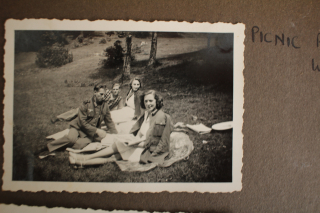
So – who were Wolffe, Hans and Molly and Joan? Well, I must come clean here and admit that my question was a rhetorical one and that I know who these black-and-white people were.
One of the girls is my aunt. The other girl is the daughter of my grandfather’s gardener. Both girls were on a trip to Germany in August 1939. One person is not shown here. Perhaps, he was taking the photos. That man was my father and he was 19 on this trip. The captions in the photograph album tell us very little about these people or about their relationships.
In fact, one could read anything into them and, like many writers do, that is exactly what I have done. Reflections on these distant figures and what might have happened to them was the inspiration for my novel, Feeling the Distance. The ambiguous nature of the title is, of course, deliberate.
Writing fiction has a variety of side effects. Jumping at will out of the head of one character and into the head of another and asking yourself questions concerning how a person feels or how a person might react in a certain situation has made me develop empathy to a much greater degree than before my writing life.
But I had to reach the half century before I realised how intricate is the relationship between thoughts and words.
„If you’ve got nothing to say, keep quiet!”
„Your writing is sloppy and should never have been written by a university student.“
Both of the comments above miss the point. The point is that our thoughts are very often formed in the process of speaking and writing and not before. In other words, we sometimes only discover what we really think and feel in the actual process of writing or speaking. Thoughts come through the pen, the electronic keyboard or are formed in the mouth.
This relationship between thoughts and words is important for writers because it stresses the necessity of the rewrite. You often hear writers say, „I don’t write books, I rewrite them.“ This is certainly true for me. I work on my chapters in the same way that a sculptor works with a block of stone. When I have finished a book, I usually wonder how on earth it came into being in the first place. Certainly, I never really know what I want to say or argue or present in a book until the first draft is out. Then, I might discuss it with friends and so begins the rewrite.

There is another point here. Discovering one’s thoughts through speech or writing can also help individuals discover who they are by expressing them. It is this relationship with others that is vital here. In other words, I am what I think I am through my relationships with other people. No wonder we can get hurt when bad reviews come in or people tell you the book was rubbish! It can feel like a very personal attack.
For those readers who want to know more about this most interesting topic I suggest s/he reads the last chapter of Lev Vygotsky’s Thinking and Speech (1934). A word of warning, however. This chapter is not for the faint-hearted. It is a long chapter with a complex argumentative structure in which Vygotsky gives his view on the relationship between thinking and speech. As a writer myself, I would not be surprised if Lev wrote innumerable drafts before producing something he was satisfied with. Perhaps, like many creative people, he was never satisfied with what he had written. Capturing those thoughts and expressing them through words or music is a formidable task.
 Thoughts and Words